
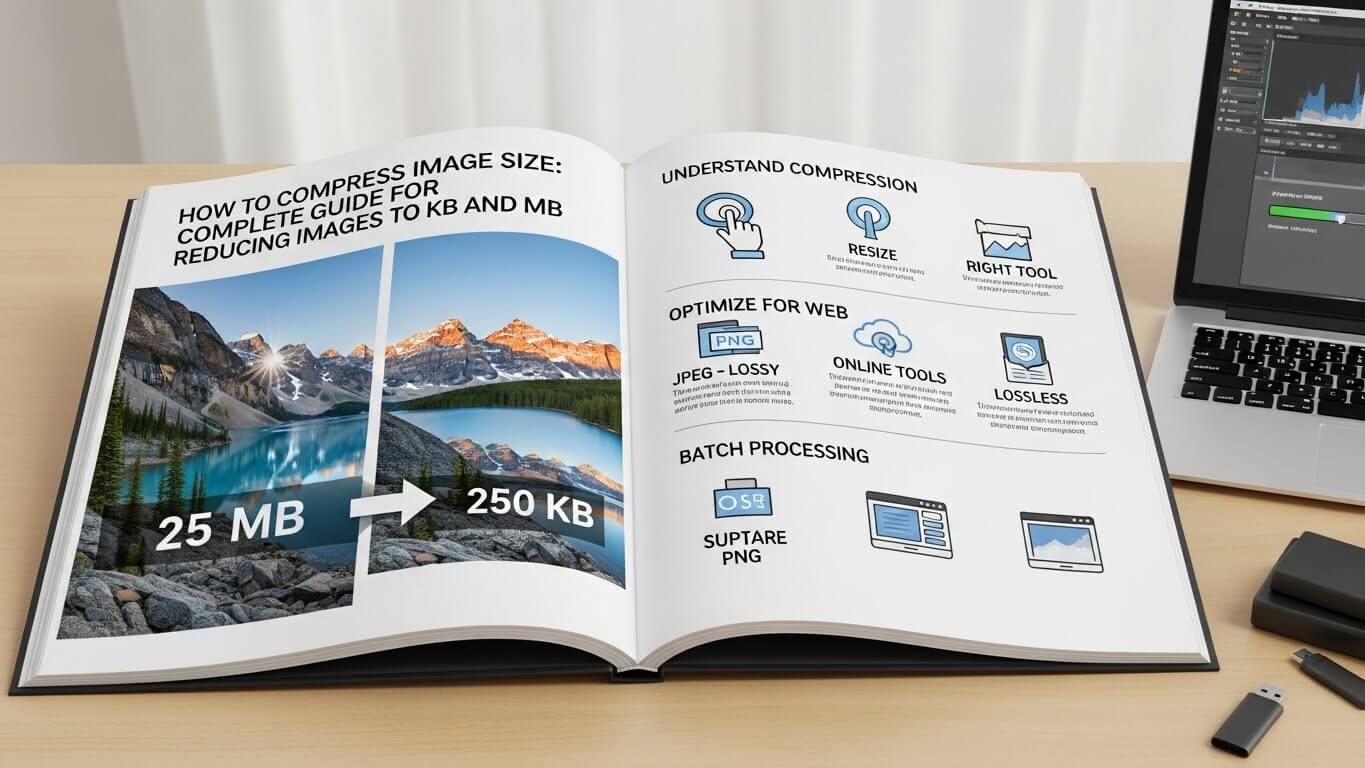
In today’s digital world, image size matters more than most people realize. Whether you are uploading photos to an online form, optimizing images for a website, or sending pictures over email, the ability to reduce file size without compromising quality is essential. Most platforms now require images to fall under specific size limits such as 10KB, 50KB, 500KB, or 1MB. That is why many users search for guides like how to compress image to 50kb or how to compress image size—because size restrictions can be frustrating when you don’t know how to meet them.
This article will serve as your ultimate guide on image compression. You will learn how image size works, why compression is needed, different compression methods, recommended tools, and step-by-step tutorials.
Why Compressing Image Size Matters
Before understanding how to reduce image file size, it’s helpful to know why it’s important.
1. Faster Website Loading
Website speed directly affects user experience and SEO. Large images slow down websites. Compressed images help pages load faster, improving ranking and usability.
2. Required by Application Forms
Government forms, job applications, schools, and online portals frequently set limits like compress image to 10kb or how to compress image to 50kb because smaller files upload faster and take less server space.
3. Storage Optimization
Phones and laptops are often cluttered with high-quality photos. Compressing images helps save space while maintaining acceptable quality.
4. Quick Sharing Online
Compressed images upload faster on slow internet connections, making them ideal for email and social media sharing.
Understanding Image Size: KB, MB, Resolution, and Formats
To effectively reduce image size, you should understand the factors that determine it.
1. File Format Matters
Different formats produce different sizes:
- JPG — small and suitable for photos
- PNG — high quality, bigger size, supports transparency
- WEBP — modern format with excellent compression
- JPEG XL — new, efficient, but less supported
2. Resolution Affects Size
High-resolution images (e.g., 4000×3000) have more pixels and therefore more data compared to lower resolutions like 1200×800.
3. Quality Percentage
Most compressors let you choose quality from 0% to 100%. Lowering quality decreases file size dramatically.
How to Compress Image to 50KB
(Keyword used here for 1st time)
Compressing an image to exactly 50KB requires careful adjustment of resolution and quality. Many forms such as government ID uploads, school admissions, and job portals require this limit.
Steps to Compress an Image to 50KB
- Upload your image to an online compressor.
- Select “target size” and set it to 50KB.
- Use JPG instead of PNG if the original is high resolution.
- Reduce resolution if the image is still too large.
- Download and verify file size.
If you follow these steps, it becomes easier to meet strict file requirements. Understanding how to compress image to 50kb is especially important when working with official applications.
(Keyword used here for 2nd time)
Compress Image to 500KB
(Keyword used here for 1st time)
Some platforms allow bigger limits like 500KB. This size is ideal for high-quality pictures used on websites, portfolios, or print previews.
Steps to Compress an Image to 500KB
- Upload the image to a compressor tool.
- Select output quality around 80–90%.
- Keep the resolution high (e.g., 1600×1200).
- Export as JPG for best results.
Designers often need to compress image to 500kb for project submissions or large uploads.
(Keyword used here for 2nd time)
How to Compress Image Size
(Keyword used here for 1st time)
Image size compression can be done through three main methods:
Method 1: Online Compressors (Fast & Easy)
Web-based tools work instantly and require no installation.
Benefits:
- Free
- Beginner-friendly
- Works on any device
Method 2: Offline Software
Programs like Photoshop, GIMP, and Paint.NET offer high control.
Method 3: Mobile Apps
Apps allow on-phone compression for people who frequently upload images.
Learning how to compress image size is essential for smooth digital communication and website management.
(Keyword used here for 2nd time)
How to Compress Image to 10KB
(Keyword used here for 1st time)
Compressing an image to 10KB is challenging because it requires extremely small file size while maintaining clarity.
Here’s how to do it:
- Start with a simple, low-resolution image.
- Convert PNG to JPG.
- Reduce colors and remove background if possible.
- Use a “target size” compressor and enter 10KB.
Government forms often require users to compress image to 10kb, especially for signatures or thumbnail photos.
(Keyword used here for 2nd time.
Compress Image to 1MB
(Keyword used here for 1st time)
A 1MB limit is generous and allows for high-quality visuals suitable for portfolios, printing, and graphic uploads.
Steps to Compress to 1MB:
- Upload a high-resolution image
- Keep quality above 90%.
- Reduce dimensions slightly if needed.
- Export in JPG or WEBP format.
Some websites and printers ask users to compress image to 1mb to maintain quality while minimizing size.
(Keyword used here for 2nd time)
Best Tools to Compress Image Sizes
1. Online Tools
These work on any device:
- TinyPNG
- ILoveIMG
- CompressJPEG
- ImageResize
- PhotoPea
2. Mobile Apps
Great for smartphone users:
- Photo Compressor
- Lit Photo
- JPEG Optimizer
- Reduce Photo Size
3. Desktop Software
Best for advanced users:
- Adobe Photoshop
- GIMP
- Affinity Photo
Tips for Better Image Compression
1. Choose the Right Format
- Use JPG for photos
- Use PNG for transparency
- Use WEBP for excellent compression
2. Reduce Resolution First
Dropping from 4000px to 1600px can reduce file size by 60–80%.
3. Avoid Over-Compression
Pixels become blurry if the quality drops too much.
4. Keep a Backup of the Original
Always store an uncompressed version for editing.
Common Problems & Solutions
Problem 1: Image becomes too blurry
Fix: Increase quality percentage.
Problem 2: File cannot reach 10KB
Fix: Resize the image to a smaller resolution.
Problem 3: PNG file too large
Fix: Convert PNG to JPG.
Problem 4: Image won’t upload
Fix: Ensure correct extension (JPG/JPEG/PNG).
Conclusion
Image compression is essential for modern digital use, from official submissions to website optimization. Whether you need to lower size for online forms, upload limits, or storage management, knowing how to adjust quality, resolution, and file format gives you complete control.
This guide covered how to reduce file sizes to popular limits like 10KB, 50KB, 500KB, and 1MB. With the right tools and techniques, anyone can compress images easily without sacrificing clarity.
If you want, I can also create:
FAQs
Q1. Can I compress an image without losing quality?
Yes, using lossless compression or WEBP format.
Q2. Which format results in the smallest file size?
WEBP usually gives the smallest size with good quality.
Q3. Is online image compression safe?
Most tools delete files automatically, but avoid uploading sensitive images.
Q4. What affects image size the most?
Resolution, format, and quality percentage.
Q5. Can I compress images in bulk?
Yes, many online tools allow batch compression.